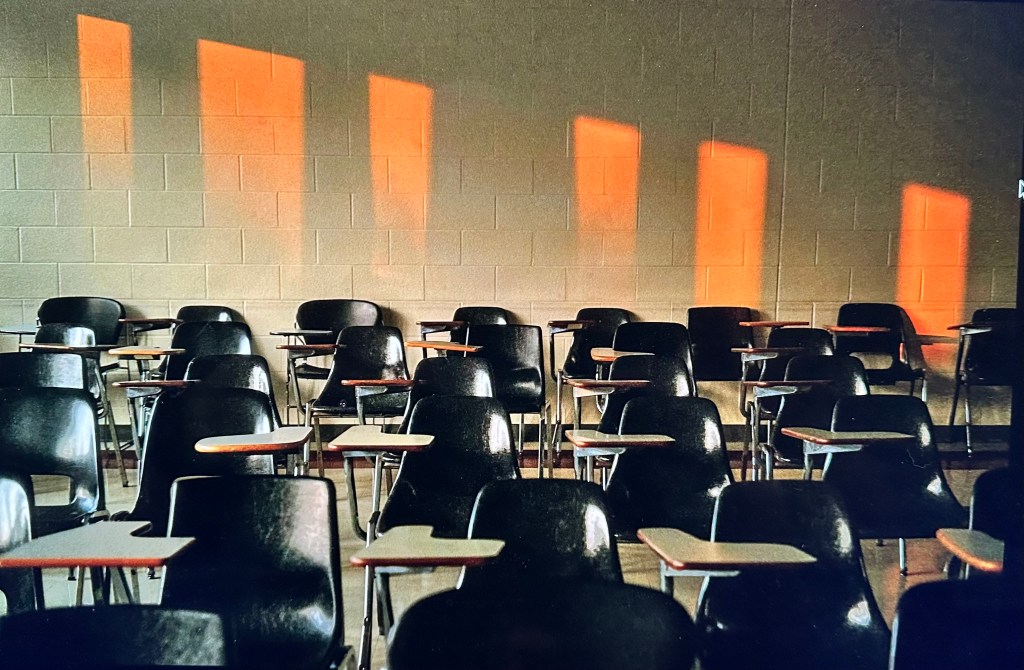
The first time I gave a speech, I didn’t give one.
I was in tenth grade, sitting in Ms. Davis’s English class, and I hadn’t prepared anything—not because I was bold or rebellious, but because I had absolutely no idea how to write a speech in the first place. No one had shown me how to build one, how to structure it, how to stand up and hold a room. I simply assumed I would figure it out when the moment came—rise to the occasion when the consequences became unavoidable.
The time came.
Ms. Davis called me to the front of the room and, for reasons that still escape me, decided to let the class choose my topic. In hindsight, that was a terrible idea.
To say I was shy doesn’t begin to cover it. I wasn’t mysterious-quiet or brooding-interesting. I was invisible-quiet—the kind that makes teachers forget to call on you. High school felt like a combat zone: unwritten rules, shifting alliances, gossip that spread faster than truth. Survival meant not drawing attention to yourself.
A girl in the front row raised her hand.
“What’s your stance on abortion?”
Thirty pairs of eyes turned toward me, safe behind their desks.
I was mortified.
I don’t remember forming a coherent thought. I remember the heat. I remember wondering why no one else had been handed something like this, why their topics had seemed lighter, safer, almost trivial. I remember my own silence stretching past what felt acceptable, then past what felt survivable. My heart pounded so hard I could feel it in my throat.
After what felt like an hour—probably ten seconds—I walked back to my seat without saying a word. I could feel the eyes on my back, hear the low snickers, see a few heads shaking as if I had failed some unnamed social test.
Ms. Davis made a mark in the book and called on someone else.
Here’s the thing everyone knows but rarely says: once you experience that kind of humiliation, you will do almost anything to avoid it.
It doesn’t just embarrass you. It becomes a memory that replays in your head over and over. After that day, I didn’t want to be brave. I wanted to be invisible. Public speaking wasn’t merely uncomfortable; it felt dangerous—not physically, but socially. When you’re already unsteady in high school, trying to move through the hallways unnoticed, social danger feels all too real.
So I avoided public speaking. For years, I stepped out of the light — made excuses, claimed illness, retreated before anyone could ask more of me. It wasn’t entirely untrue.
Somewhere along the way, I don’t remember exactly when, I made a quiet deal with myself. I didn’t have to be confident. I didn’t have to be polished, or impressive, or even particularly good. I just had to survive five minutes.
Five minutes felt manageable. Five minutes didn’t feel like forever. Five minutes was something I could endure without imagining the rest of my life collapsing under it. I can do anything for five minutes.
I didn’t have to conquer fear. I just had to sit next to it for a little while, like a staring contest, deciding not to blink first.
Years later, I realized I was using that same strategy in other parts of my life. In college, I found myself in a karate class. One afternoon, while joking around, I did a loud, over-the-top Bruce Buffer impression—“Let’s get ready to rumble!”—and the class burst out laughing. They clapped me on the back, surprised. “I can’t believe you can do that.”
I forgot about it. Until months later, our karate group needed an announcer.
A few students were stepping into the cage for an MMA event, and we were holding the weigh-in at a local bar. The instructor looked around the room, and slowly—almost comically—every set of eyes landed on me.
Surrounded by friends, inside the comfort of the dojo, I shrugged. “Sure. I’ll do it.” It felt easy there.
The bar was very different. It was late and packed, strangers pressed shoulder to shoulder, phones already out, the lights harsher than they needed to be. My hands began to tremble. Suddenly I was back in Ms. Davis’s classroom, except this time the room was filled with adults—background noise rising and falling, drinks in hand, expectation settling over the space.
The heat on my face returned. My throat tightened, heart beating fast. Every exit in the room became visible.
Yet this time, I had a choice. I didn’t need to be fearless for the rest of my life. I didn’t need to prove anything grand. I just needed to survive five minutes—five minutes of voice, five minutes of standing upright, five minutes of not walking away.
So I stepped up to the microphone, made a few introductions—trying to keep my voice from cracking—welcomed the crowd, and let it rip.
“LET’S GET READY TO RUMBLE!” Flawless. Like a crowing rooster at dawn.
The room erupted. Cheers cracked the air. Laughter rolled across the bar. Phones lifted higher—recording, flashing, feeding the noise.
Five minutes passed.
I announced fighters, called out weights, even slipped into a few Bruce Buffer–inspired sponsor lines. I didn’t sit down. I didn’t shrink back.
I felt like someone else.
Something happened no one had warned me about.
The fear didn’t disappear, but changed. The tightness in my chest dissolved, replaced by something electric, almost intoxicating. My body, which moments earlier had felt ready to shrink back down, now felt weightless and charged. Words came easier. My voice settled into the Bruce Buffer rhythm.
The room leaned in. Faces that had felt intimidating minutes earlier now looked welcoming. Almost friendly.
It was as if all that heat that once burned my face had been redirected—turned outward instead of inward. What had been panic became fuel.
The rush lasted long after the microphone was lowered. For hours, I felt buoyant, giddy in a way that bordered on disbelief. I replayed the moment again and again, not to cringe this time, but to marvel that I hadn’t sat back down.
Eventually, the crash came. Not humiliation or shame, just exhaustion. The kind that follows a hard workout or a long tournament, when adrenaline burns off and the body hits a wall.
Later, when I started submitting my writing publicly, I wasn’t confident then either. I just told myself the same thing: send the email. Hit publish. You only have to be brave for a few minutes.
The pattern was always the same. Don’t ask, “Can I do this forever?”
Ask, “Can I do this for five minutes?”
We talk about bravery as if it’s a personality trait, something wired into certain people at birth. I am not so certain that’s true.
I think most of us are simply negotiating with fear. We tell ourselves we’re waiting for confidence, that we’ll start when we feel ready. The funny thing is, taking action while we’re still scared is what comes first. Confidence is what shows up after you survive the five minutes. Once you do it once, the next stretch feels slightly less impossible. Slightly more manageable.
The memory of that tenth-grade silence hasn’t disappeared. I still remember the heat rising in my face, but it doesn’t control me anymore.
It taught me something. I don’t need to be fearless. I don’t need perfect timing or certainty. I just need five minutes.
I can do anything for five minutes.
— Dennis D. Montoya
Stories Forged in Ink and Ash
If you enjoyed this, hit subscribe. That way you’ll never miss another awkward comment, cringe-worthy moment, or accidental success.
 Dennis D Montoya